One-Stop PCB Factory: Prototype to Mass Production
For hardware startups and OEMs, getting high-quality PCBs quickly and reliably is critical. MC PCB is a one-stop contract PCB manufacturer supporting prototypes to volume builds—backed by experienced engineering support and rigorous QA.
MC PCB Co., Ltd.
Began in 2005
One-Stop PCB Factory: Prototype to Mass Production
For hardware startups and OEMs, getting high-quality PCBs quickly and reliably is critical. MC PCB is a one-stop contract PCB manufacturer supporting prototypes to volume builds—backed by experienced engineering support and rigorous QA.
MC PCB Co., Ltd.
Began in 2005
No. 2, Lane 11, Wenming Road, Fourth Industrial Zone, Nanzha, Humen Town, Dongguan City
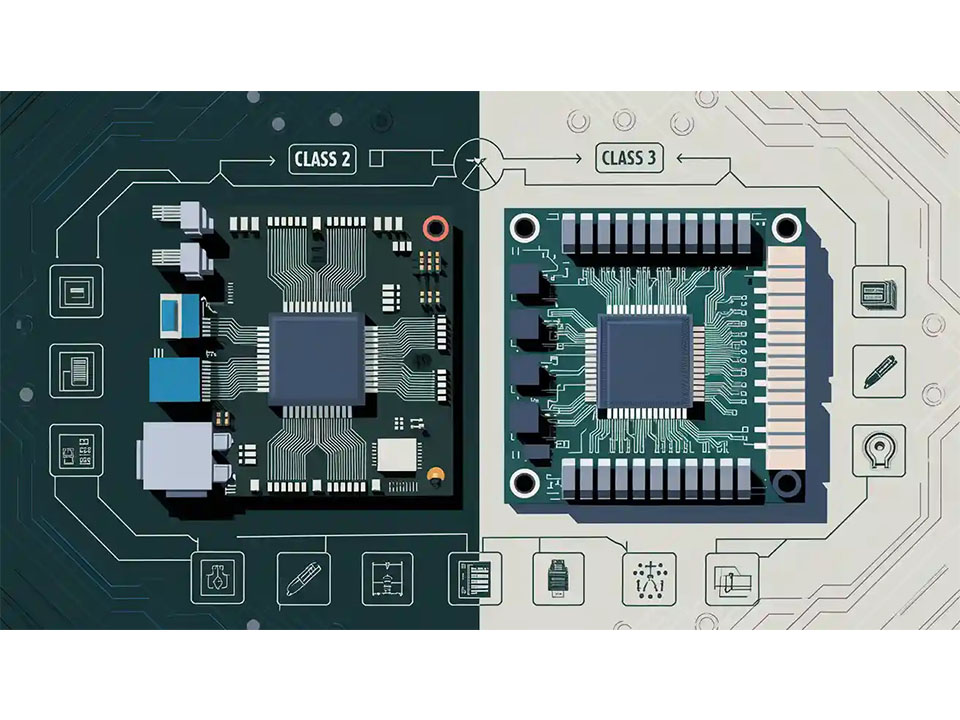
People love to write “IPC Class 3” on a PO like it’s a one-line shortcut to bulletproof reliability. In real production, it’s not that simple. Class 2 and Class 3 target different failure risk, different acceptance limits, and different inspection behavior. That choice can change your pad sizes, drill tolerance budget, plating targets, and even how many boards get stuck in a CAM hold.
If you’re sourcing from a China B2B PCB factory for fast prototyping, volume builds, or turnkey assembly, you’ll get better results when you match the class to the product’s real-life duty cycle, not the marketing pitch.
You can see what we build and how we run QC on our homepage, then jump into PCB fabrication or PCB assembly depending on whether you need bare boards or full PCBA.
IPC-6011 product class definitions
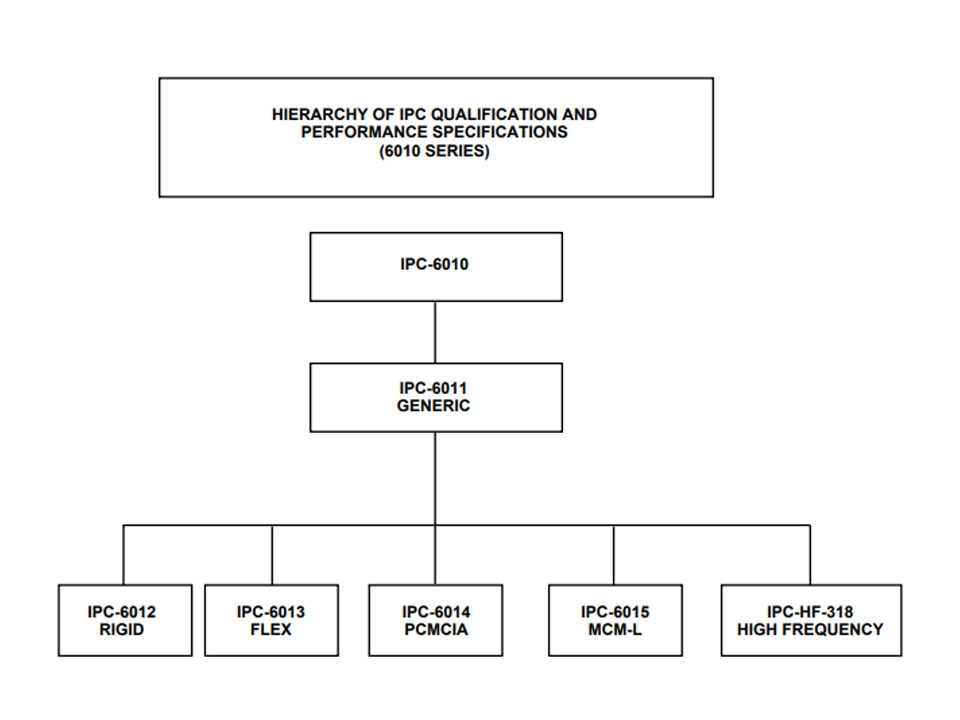
Here’s the core idea straight from the IPC class definitions (IPC-6011 family wording is the usual reference people cite):
IPC Class 2 fits dedicated service products. You expect good life and stable function, but you can tolerate maintenance and occasional downtime.
IPC Class 3 fits high reliability products. You need performance “on demand,” and you can’t tolerate downtime.
That “downtime tolerance” line is the fastest way to decide. If a failure becomes a service ticket, Class 2 is often fine. If a failure becomes a safety issue, a grounded system, or a production line stop, Class 3 starts to make sense.
IPC Class 2 vs Class 3 key differences (engineering view)
This is the stuff that actually changes your design rules and your factory’s process window.
Plated through-hole copper thickness (IPC-6012)
Most teams anchor the Class 2 vs Class 3 talk on PTH barrel copper thickness (IPC-6012 style requirements).
Commonly referenced minimums in industry practice:
Class 2: 0.8 mil minimum copper in the plated through-hole barrel
Class 3: 1.0 mil minimum copper in the plated through-hole barrel
Why you should care: thicker barrel copper raises your margin against thermal cycling fatigue. It also tightens plating control, especially on high aspect ratio drills. If you’re doing dense via fields, thicker boards, or fine drill, Class 3 can force tougher process capability.
Copper voids in hole-wall plating
A void in the hole wall means the copper isn’t continuous. You’re exposing dielectric inside the barrel. That’s a reliability risk because it concentrates stress. Over time, it can turn into a crack, an intermittent open, or a hard fail after enough temperature swings.
Typical acceptance direction:
Class 2 may allow limited voiding under specific conditions.
Class 3 is treated much more strictly. Many buyers write it as “no voids” for hole-wall plating acceptance.
If you run power cycling, outdoor installs, or harsh temperature ranges, this topic matters more than cosmetics ever will.
Annular ring and drill breakout (IPC-A-600 / IPC-6012)
Annular ring is the copper “donut” around a drilled hole. Drill breakout is what happens when the hole isn’t perfectly centered and it chews into that donut.
General pattern:
Class 2 allows more tolerance, as long as electrical spacing and functional integrity stay OK.
Class 3 tightens acceptance. Less breakout. More emphasis on intact ring and robust land geometry.
What this means in DFM terms: if you want Class 3, you usually need more pad-to-drill margin. If your library is aggressive (tiny pads, tight drills), expect DFM feedback like “increase pad” or “relax drill-to-copper.” That’s not the factory being difficult. That’s how they keep you out of reject-land.
Through-hole barrel fill (J-STD-001 / IPC-A-610)
Barrel fill is mainly a PCBA inspection topic. It’s how much solder fills the plated hole around a lead.
A common rule-of-thumb you’ll see in purchasing specs:
Class 2: 50% barrel fill
Class 3: 75% barrel fill
Reality check: barrel fill rules vary by joint type, document, and revision. So don’t rely on a vague “Class 3 assembly” note. If barrel fill is critical for your product, call it out explicitly in your assembly requirements and inspection checklist.
If you’re running high thermal mass parts, thick boards, or dense through-hole connectors, barrel fill will drive your process window and rework rate.
Inspection and acceptance criteria
Class 3 isn’t just “better.” It’s more conservative in accept/reject.
More things get flagged.
More borderline joints go to rework.
More boards spend time under inspection, not in shipping.
That matters for NPI schedules. If you’re in a tight sprint (EVT/DVT/PVT), you want to align the acceptance criteria early, otherwise you’ll burn days arguing over what’s “acceptable.”
If you want to see how we structure quality control on real builds, check the Quality page and the process scope on Capabilities.
IPC Class 2 vs Class 3 comparison table
Topic (keyword)
IPC Class 2 (typical direction)
IPC Class 3 (typical direction)
What it changes in real work
Source standard
Product class definition
Dedicated service, maintenance acceptable
High reliability, downtime not acceptable
Sets risk tolerance and acceptance mindset
IPC-6011
PTH copper thickness
Often referenced around 0.8 mil min
Often referenced around 1.0 mil min
Plating control, via robustness, aspect ratio sensitivity
IPC-6012
Hole-wall copper voids
Limited voiding may be allowed by criteria
Much stricter; often treated as “no voids”
Long-term reliability under thermal cycling
IPC-6012 / IPC-A-600
Annular ring / drill breakout
More tolerance if function and spacing hold
Tighter limits; less breakout
Pad sizing, drill tolerance budget, yield headroom
IPC-A-600 / IPC-6012
Barrel fill (assembly)
Often specified lower in buyer specs
Often specified higher in buyer specs
Assembly window, inspection time, rework risk
J-STD-001 / IPC-A-610
Inspection strictness
Practical acceptability
Conservative acceptability
More holds, more rework decisions
IPC-A-600 / IPC-A-610
How to choose IPC Class 2 or Class 3 by use case
IPC Class 2 typical scenarios
Class 2 fits most commercial and industrial products where:
You can handle field repair or module swap.
Downtime is annoying but not catastrophic.
You’re optimizing for stable output and scalable volume.
Examples you’ll recognize:
Smart display control boards
Industrial controllers with service access
Appliance control boards
IoT gateways in normal indoor environments
If you’re doing control boards or quick-turn builds, start with PCB fabrication for the bare board scope, then move to PCB assembly when you’re ready for turnkey.
IPC Class 3 typical scenarios
Class 3 makes sense when failure has a big downside:
Safety risk
Mission-critical uptime
Harsh temperature, shock, vibration
Long service life with minimal maintenance
Examples:
Automotive control modules with heat and vibration
Medical electronics that can’t “just reboot”
Critical comms and outdoor infrastructure
If you’re working on high-density, impedance-controlled, or advanced stackups, check Advanced PCB so your stackup, drill map, and DFM rules match the class target from day one.
Practical PO notes that prevent “DFM ping-pong”
Here’s how to avoid the classic back-and-forth that burns your schedule:
Name the standard and the class Don’t write only “Class 3.” Specify whether you mean bare board (IPC-6012 / IPC-A-600 acceptance) or assembly (J-STD-001 / IPC-A-610).
Call out the stress points If your product lives in thermal cycling, say so. If via reliability is critical, call out PTH copper and void criteria. If press-fit or heavy connectors matter, call out barrel fill and hole quality.
Align library geometry with the class Many “Class 3 failures” are really library problems: pads too tight, drill tolerance too aggressive, annular ring too skinny. Fix that upstream and your yield looks a lot nicer.
If you want a fast review path, send your Gerbers, stackup notes, and acceptance requirements through Contact Us. If you’d rather browse similar builds first, check Products for examples across different board types and customer needs.
MC PCB.,Ltd, alongside Dongguan MaoChang Printed Circuit Board Limited,has focused on PCB manufacturing over 20 years. MaoChang Printed Circuit Board Limited, a professional PCB factory for Quick Turn PCB, Prototype PCB and High Mix Low Volume fabrication. With UL certification for Rigid FR-4 / High Frequency / Aluminum Based PCB production.
Company
About
Contact
Capabilities
Services
Application
Products
Quality
Blog
Products
Printed Circuit Boards
PCB Prototype
Flexible PCB
High Frequency PCB
Thick-Copper PCB
PCB Assembly
Metal core PCB
Thick-Copper PCB
Contact
0755-2889 4567
Room 1803, lA Building, Longwan, Nanhuai Road, Shajing, Bao'an District,Shenzhen City
No. 2, Lane 11, Wenming Road, Fourth Industrial Zone, Nanzha, Humen Town, Dongguan City