One-Stop PCB Factory: Prototype to Mass Production
For hardware startups and OEMs, getting high-quality PCBs quickly and reliably is critical. MC PCB is a one-stop contract PCB manufacturer supporting prototypes to volume builds—backed by experienced engineering support and rigorous QA.
MC PCB Co., Ltd.
Began in 2005
One-Stop PCB Factory: Prototype to Mass Production
For hardware startups and OEMs, getting high-quality PCBs quickly and reliably is critical. MC PCB is a one-stop contract PCB manufacturer supporting prototypes to volume builds—backed by experienced engineering support and rigorous QA.
MC PCB Co., Ltd.
Began in 2005
No. 2, Lane 11, Wenming Road, Fourth Industrial Zone, Nanzha, Humen Town, Dongguan City
What are the design rules for flexible circuits to ensure reliability during bending?
Design flexible circuits that survive bending: pick the right bend radius, thin the stack, avoid vias in bend zones, and add strain relief for long life.
Flexible circuits fail in boring, predictable ways. You don’t usually lose the whole board. You get an intermittent open that shows up after a few thousand bends, or a dead unit after final assembly because the flex got creased one time too many. If you want real bending reliability, design the flex like it’s going to be abused—because in production, it will.
I’ll walk you through practical design rules you can hand to your layout team and your PCB supplier. I’ll also tie them to real build scenarios you’ll see in OEM/ODM work: wearables, foldables, camera modules, drones, and tight industrial enclosures.
If you’re sourcing in China for quick-turn builds and volume ramps, you’ll also want tight DFM alignment between design and fab/assembly. Our site pages on PCB fabrication, PCB assembly, capabilities, and quality control cover how we handle that end-to-end for B2B customers.
Flexible circuit bending reliability during bending
Here’s the core idea: bending creates strain. Strain concentrates at weak spots. Copper fatigues, cracks, and turns into an open circuit. Your job is to lower strain and remove stress risers in the bend zone.
Two common setups behave very differently:
Static flex: you bend it once during assembly, then it stays put (think: a folded sensor module inside a plastic shell).
Dynamic flex: it keeps moving for life (think: hinge, slider, foldable screen, printhead, or a flex tail that cycles every use).
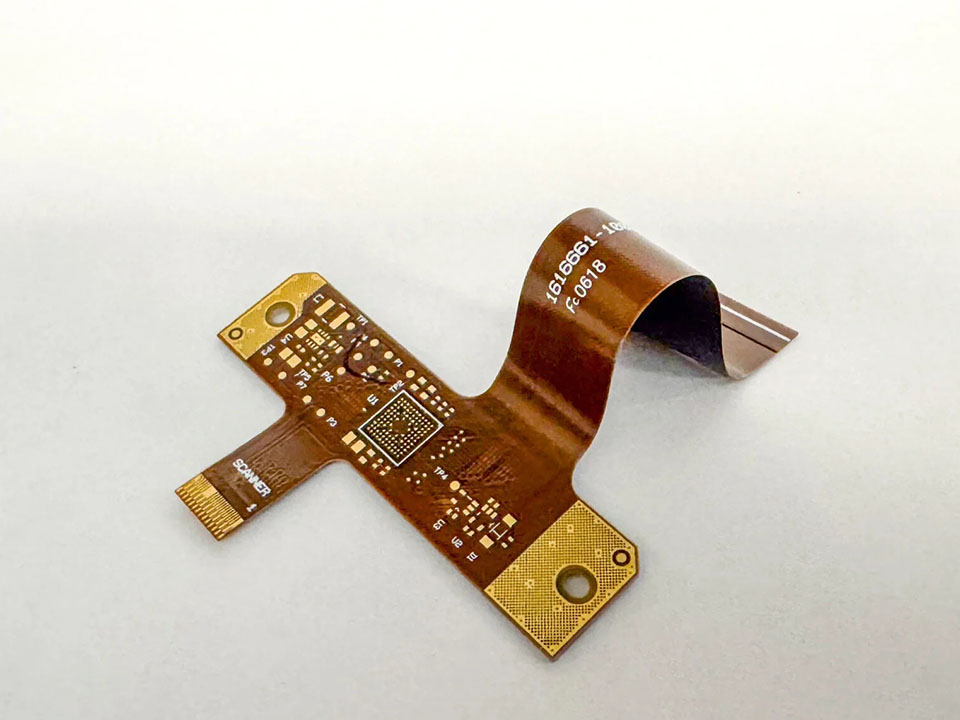
If you’re building anything hinge-like, consider rigid-flex early, not late. It often simplifies connectors and improves assembly yield. See typical builds like a rigid-flex PCB for foldable flex circuits.
Bend radius and bend ratio
Design rule 1: Set bend radius first, then lock stackup thickness
If you pick the mechanical envelope late, you’ll end up forcing a tight radius onto a thick stack. That’s how copper cracks get born.
What to do
Define a minimum bend radius based on the product’s mechanical model.
Then build the flex stack to hit a safe bend ratio (bend radius ÷ total thickness).
Design rule 2: Use different minimum bend ratios for single-layer vs multilayer flex
Multilayer flex is stiffer. It pushes more strain into outer copper layers during a bend. So the “same radius” isn’t the same risk.
Practical target
Treat single/double-layer flex as easier to bend.
Treat multilayer flex as higher risk and require a more conservative bend ratio.
If you’re quoting or DFM’ing a flex build, align bend radius and stackup early with your supplier. For flex-heavy sourcing, you can cross-check with a dedicated custom FPC flexible PCB manufacturer page to confirm what constructions are realistic at scale.
Avoid stacking extra layers or stiffeners across the bend.
Design rule 4: Prefer adhesiveless constructions when bending is critical
Adhesive layers add thickness and can hurt long-term reliability. If your product bends a lot, adhesiveless material systems usually behave better.
This matters in wearables and compact consumer hardware where every millimeter fights you.
Copper and plating choices
Design rule 5: Avoid plated copper in the bend zone
Plated copper can be less ductile than rolled-annealed copper and tends to fatigue sooner in repeated bending.
How teams handle this
Use plating only where you need it (pads/through-hole features).
Keep long traces in the bend zone as “clean” copper, not built up by plating processes.
Bend area layout and routing
Design rule 6: Keep vias, holes, and openings out of the bend zone
Vias and cutouts behave like crack starters. Even if they don’t fail on day one, they shorten fatigue life fast.
DFM tip
Mark the bend zone as a keepout for vias, tooling holes, and coverlay windows.
If you must transition layers, do it outside the bend and run the traces straight through the flexing section.
Design rule 7: Route traces perpendicular to the bend line when you can
When traces cross the bend line cleanly, strain spreads more evenly. When traces run along the bend, they can see higher tensile stress over a longer length.
Reality check
Sometimes you can’t get perfect routing. In that case, minimize long parallel runs inside the bend and push them outward.
Design rule 8: Replace 90° corners with arcs and teardrops
Sharp corners concentrate stress. In flex, that’s like scoring a sheet of metal and then bending it on the score line.
Do this
Use curved trace corners.
Add teardrops at pad-to-trace transitions, especially near any mechanical constraints.
Rigid-flex transition and strain relief
Design rule 9: Treat the rigid-to-flex boundary like a danger zone
Most field returns show damage right where “hard meets soft.” That boundary likes to crack copper, split coverlay edges, or delaminate if you don’t manage stress.
What works
Add strain relief features.
Use smooth transitions and sensible stiffener geometry.
Design rule 10: Avoid solid copper pours across the bend; consider crosshatch
A big solid plane turns your flex into a spring steel strip. It raises bending force, shifts the neutral axis, and can drag traces into higher strain.
Common compromise
Use crosshatch/mesh in the bend area when EMI and return paths allow.
Split pours so they don’t bridge the flexing section like a strap.
Reliability test plan and manufacturing controls
Design rule 11: Write bend life into the spec and test it with coupons
If you don’t define bend cycles, radius, and motion type, you’re guessing. And guessing gets expensive when you hit volume.
What to specify
Static vs dynamic bending
Minimum bend radius
Number of cycles (for dynamic)
Temperature range if it’s harsh environment
Design rule 12: Close the loop with DFM, stackup review, and process discipline
Flex isn’t forgiving. You need your fab and PCBA steps aligned: coverlay registration, stiffener placement, trace geometry, and handling rules on the assembly line.
If your program includes turnkey builds (fabrication + SMT + functional test), tie requirements into one flow. That’s the whole point of a B2B line that does prototype-to-volume with consistent quality gates. You can also point internal stakeholders to the homepage and the services overview to align purchasing, engineering, and NPI on the same supplier scope.
Design rules summary table with sources
Below is a compact checklist you can paste into a design review doc. “Source” here means the kind of reference engineers typically use: IPC guidance, flex circuit manufacturer design guides, and rigid-flex best-practice playbooks (named, no external links).
Design rule (argument title)
What to do in layout/stackup
Why it improves bending reliability
Source (document family)
1) Set bend radius first, then lock thickness
Define min radius early; design stack to it
Lower strain from the start
Flex circuit manufacturer design guides
2) Use different minimum bend ratios by layer count
Use conservative ratio for multilayer
Multilayer pushes higher outer-layer strain
Manufacturer bend ratio guidance + IPC approach
3) Make the bend zone thinner
Thin dielectric/copper in bend area
Lower stiffness and fatigue stress
Manufacturer stackup guidelines
4) Prefer adhesiveless constructions
Choose adhesiveless where bending is critical
Less thickness, fewer interface risks
Material system guidance + flex design guides
5) Avoid plated copper in the bend zone
Restrict plating to pads/features
Better ductility, longer fatigue life
Flex reliability guides (rolled copper focus)
6) Keep vias/holes out of bend zone
Via keepout in bend area
Removes crack starters and stress risers
IPC-2223 style constraints + fab DFM rules
7) Route traces perpendicular to bend line
Cross bend line cleanly when possible
Spreads strain more evenly
Flex routing best practices
8) Use arcs/teardrops, avoid sharp corners
Curved corners + teardrops
Reduces stress concentration
PCB layout reliability playbooks
9) Protect rigid-flex transition
Strain relief + component keepout
Boundary is a common failure point
Rigid-flex design best practices
10) Avoid solid pours across bend; crosshatch
Mesh pours or split planes in bend
Controls stiffness and neutral axis
Flex EMC/layout guidelines
11) Specify bend life and test coupons
Define cycles, radius, temp; run bend tests
Validates fatigue life before launch
Reliability test methods used in flex programs
12) Enforce DFM + process discipline
Stackup review, coverlay/stiffener control
Prevents “built wrong” failures
NPI/DFM workflows in PCB fab/PCBA
Real-world scenarios that drive the rules
Wearables and medical sensors
You’ll see dynamic flex around straps, hinge points, or cable tails that get flexed during daily use. Push for thinner bend zones, via keepouts, and gentle routing. These products also hate intermittent faults because debugging in the field is brutal.
Foldables and camera modules
These often mix tight packaging with repetitive motion. Rigid-flex can reduce connector count, improve assembly consistency, and keep the bend mechanics predictable. Don’t let the rigid-flex boundary sit right at a hinge stress peak.
Drones and industrial service loops
Service loops bend during vibration and maintenance. You want robust strain relief and conservative bend ratios, plus a defined bend test plan before you commit to volume.
Quick takeaway
If you remember only three things, remember these:
Bigger bend radius + thinner stack = lower strain.
No stress risers in the bend zone (vías, holes, sharp corners, openings).
Treat rigid-to-flex transitions and manufacturing controls as first-class design work, not cleanup.
If you want, I can also adapt this into a supplier-ready DFM checklist (Gerber notes + stackup callouts + bend zone drawing notes) that your OEM/EMS partners can execute without back-and-forth.
MC PCB.,Ltd, alongside Dongguan MaoChang Printed Circuit Board Limited,has focused on PCB manufacturing over 20 years. MaoChang Printed Circuit Board Limited, a professional PCB factory for Quick Turn PCB, Prototype PCB and High Mix Low Volume fabrication. With UL certification for Rigid FR-4 / High Frequency / Aluminum Based PCB production.
Company
About
Contact
Capabilities
Services
Application
Products
Quality
Blog
Products
Printed Circuit Boards
PCB Prototype
Flexible PCB
High Frequency PCB
Thick-Copper PCB
PCB Assembly
Metal core PCB
Thick-Copper PCB
Contact
0755-2889 4567
Room 1803, lA Building, Longwan, Nanhuai Road, Shajing, Bao'an District,Shenzhen City
No. 2, Lane 11, Wenming Road, Fourth Industrial Zone, Nanzha, Humen Town, Dongguan City