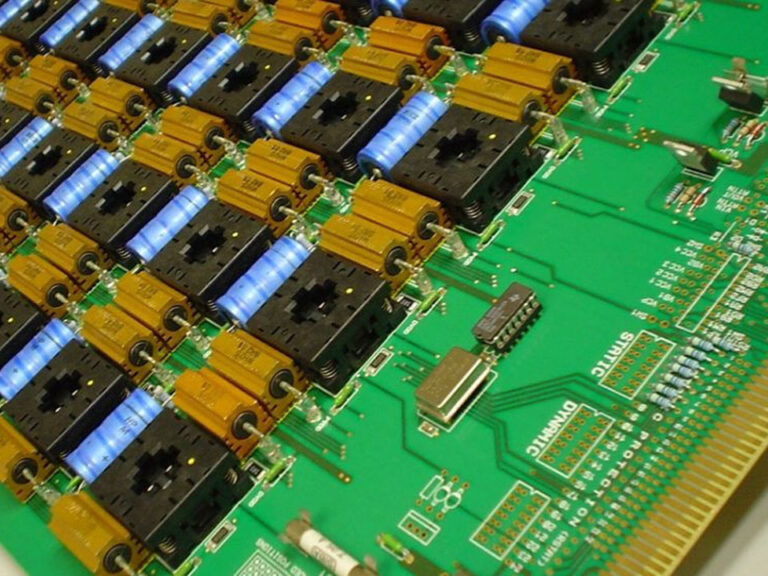
One-Stop PCB Factory: Prototype to Mass Production
For hardware startups and OEMs, getting high-quality PCBs quickly and reliably is critical. MC PCB is a one-stop contract PCB manufacturer supporting prototypes to volume builds—backed by experienced engineering support and rigorous QA.
MC PCB Co., Ltd.
Began in 2005
One-Stop PCB Factory: Prototype to Mass Production
For hardware startups and OEMs, getting high-quality PCBs quickly and reliably is critical. MC PCB is a one-stop contract PCB manufacturer supporting prototypes to volume builds—backed by experienced engineering support and rigorous QA.
MC PCB Co., Ltd.
Began in 2005
No. 2, Lane 11, Wenming Road, Fourth Industrial Zone, Nanzha, Humen Town, Dongguan City
Is HDI Necessary? Density vs Cost Trade-Off Analysis
HDI isn’t always needed. See how routing density, microvias, via-in-pad, and lamination steps shift PCB cost, yield, and lead time for OEMs. And EMS builds too.
You’ve got a board that’s getting cramped. The BOM is locked. The enclosure won’t grow. Then someone asks the classic question: Do we really need an HDI PCB, or are we just making the build harder and pricier? Here’s the straight answer: HDI isn’t a badge of honor. It’s a tool. Use it when routing density and interconnect limits corner you, and skip it when a simpler stack-up hits your targets.
If you’re sourcing from a China B2B factory for fast prototyping, mass production, and PCB assembly, you’ll win more often when you treat HDI as a trade study, not a default.
HDI PCB isn’t always required, but routing density can force it
When density is low, a standard through-hole via board usually ships faster and runs with better yield. But density climbs in a hurry with:
Fine-pitch BGA escape routing
High I/O packages packed into a fixed outline
Mixed-signal layouts where return paths and spacing rules tighten
“Connector-rich” designs with wide keepouts and strict mechanical zones
In real projects, the “need” for HDI usually shows up as capacity shortfall:
You can’t fan out the BGA without breaking rules.
You keep adding layers and still can’t close routing.
Your via fields block key differential pairs and power pours.
If that’s your situation, consider HDI before you burn another layout spin. For a quick overview of what HDI options your supplier can actually build, check the capabilities page: PCB manufacturing capabilities and advanced PCB services.
Wiring density vs cost trade-off
People talk about “HDI cost” like it’s one number. In practice, cost shifts because HDI changes the whole geometry of your board:
You may reduce layer count because microvias free routing channels.
You may shrink board size because you escape BGAs with less real estate.
Or you may add process steps that push yield risk and cycle time up.
So the right question isn’t “Is HDI expensive?” It’s: Which option gets you to a manufacturable layout with stable yield and predictable lead time?
You’re paying for copper planes and routing channels you still can’t use well
Re-stack signals, tighten return path planning, push some rails to polygons
HDI to open routing channels without bloating layers
Critical pairs can’t find a path
Via farms block diff pairs and reference planes
Move connectors, shift via grids, define routing corridors early
HDI to cut via land usage and shorten stubs
Board outline is frozen
Enclosure, thermal, or mechanical constraints won’t move
Swap package, split board, use rigid-flex in extreme cases
HDI to hit density inside the fixed outline
If you want this evaluated in a DFM-friendly way, start from your fab + assembly flow: PCB fabrication and PCB assembly.
Sequential lamination increases process steps and risk
Here’s the part that bites OEMs and EMS teams during scaling: HDI often introduces sequential lamination. More lam cycles mean:
More registration risk
More opportunities for defects
More variables that hit yield during volume ramp
That doesn’t mean “avoid HDI.” It means don’t over-design the stack-up. If a 1+N+1 structure closes routing, don’t jump to deeper builds just because it feels safer. The safest stack-up is the one your supplier can repeat cleanly at production volumes with consistent QC.
If your program is a quick-turn prototype today and a volume order tomorrow, align the quality gates early: quality control.
Stacked microvias vs staggered microvias is a density vs manufacturability choice
This is one of the biggest HDI forks in the road:
Stacked microvias push density harder and can help with ultra-tight BGA escape.
Staggered microvias usually manufacture more comfortably and can be easier to keep stable in production.
Think of it like traffic lanes. Stacked vias let you “go vertical” faster, but you’re also asking for more perfect alignment and more demanding processing. Staggered structures take a little more area, but they can reduce process stress.
If you’re building boards for OEM products that need reliable scaling, the “best” structure is often the one that gives you repeatable yield, not the one that looks coolest in a stack-up drawing.
Via-in-pad improves density and signal integrity, but it adds extra steps
When you’re under a tight BGA, via-in-pad can feel like the only way out. It also helps with:
Shorter interconnects
Cleaner return paths
Less via stub pain on high-speed nets
But it’s not “free.” Via-in-pad usually brings extra processing controls (like filling and capping) and tighter inspection requirements. If you’re building a phone mainboard-style layout, a wearable, or any high-density module, plan those constraints early. Otherwise, you’ll get hit with late DFM changes that wreck your schedule.
If you’re unsure whether your design needs HDI, don’t guess. Send the stack-up intent and BGA details during quoting, or route a small “DFM coupon” region first to validate escape feasibility.
Mechanical drilling can dominate cost drivers when hole count explodes
Even without HDI, boards get expensive when drill hits explode:
Lots of small mechanical holes
Dense via grids across large areas
Multiple connector zones that force stitching vias
HDI can reduce some mechanical drilling by shifting critical fanout to microvias. On the other hand, an aggressive HDI build can add its own complexity elsewhere. The move here is simple: treat hole strategy like a first-class design item. Don’t wait until layout is “done.”
Layer count vs board size is where HDI can actually win
This is the “surprise” outcome many teams miss. Sometimes HDI wins because it lets you:
Drop layers (less material, simpler lamination flow)
Shrink the outline (better panel utilization, easier mechanical integration)
Reduce rework and respins (cleaner routing closure)
No, you shouldn’t promise savings without a quote. But you can absolutely design for a lower total risk profile: fewer layout iterations, fewer ECOs, fewer last-minute compromises.
Practical scenarios OEM and EMS teams see every week
Consumer device mainboard: fine-pitch BGA + tight outline. HDI often becomes the shortest path to closure.
Industrial control: lots of connectors and spacing rules. You might skip HDI and instead optimize via grids, layer planning, and routing corridors.
Medical and automotive electronics: reliability and traceability matter. A conservative HDI approach can beat an extreme stack-up that’s hard to scale.
RF/high-speed modules: interconnect length and return paths can drive you toward microvias even when density feels “okay.”
If your team is juggling prototype, small-batch, and OEM/ODM scale-up, keep your supplier touchpoints simple: About us and Contact us. If you want broader use-cases, browse applications.
If your layout closes cleanly with a standard stack-up, don’t force HDI. But if density pressure keeps blowing up your layer count, blocking critical routing, or causing SI headaches, HDI can be the most practical way to protect schedule and yield.
MC PCB.,Ltd, alongside Dongguan MaoChang Printed Circuit Board Limited,has focused on PCB manufacturing over 20 years. MaoChang Printed Circuit Board Limited, a professional PCB factory for Quick Turn PCB, Prototype PCB and High Mix Low Volume fabrication. With UL certification for Rigid FR-4 / High Frequency / Aluminum Based PCB production.
Company
About
Contact
Capabilities
Services
Application
Products
Quality
Blog
Products
Printed Circuit Boards
PCB Prototype
Flexible PCB
High Frequency PCB
Thick-Copper PCB
PCB Assembly
Metal core PCB
Thick-Copper PCB
Contact
0755-2889 4567
Room 1803, lA Building, Longwan, Nanhuai Road, Shajing, Bao'an District,Shenzhen City
No. 2, Lane 11, Wenming Road, Fourth Industrial Zone, Nanzha, Humen Town, Dongguan City