One-Stop PCB Factory: Prototype to Mass Production
For hardware startups and OEMs, getting high-quality PCBs quickly and reliably is critical. MC PCB is a one-stop contract PCB manufacturer supporting prototypes to volume builds—backed by experienced engineering support and rigorous QA.
MC PCB Co., Ltd.
Began in 2005
One-Stop PCB Factory: Prototype to Mass Production
For hardware startups and OEMs, getting high-quality PCBs quickly and reliably is critical. MC PCB is a one-stop contract PCB manufacturer supporting prototypes to volume builds—backed by experienced engineering support and rigorous QA.
MC PCB Co., Ltd.
Began in 2005
No. 2, Lane 11, Wenming Road, Fourth Industrial Zone, Nanzha, Humen Town, Dongguan City
What’s the difference between HASL, ENIG, OSP, and immersion silver surface finishes?
Learn the real differences between HASL, ENIG, OSP, and immersion silver PCB finishes—flatness, solderability, shelf life, and best-fit build scenarios.
When you order PCBs, the surface finish isn’t a small detail. It decides how well pads wet during reflow, how flat your land patterns stay for fine-pitch parts, how long boards can sit on a shelf, and how many headaches you’ll get during SMT.
If you’re buying from a China PCB B2B factory that supports quick-turn prototyping, volume builds, and PCB assembly, you’ll usually pick from four common options: HASL, ENIG, OSP, and immersion silver. This guide breaks down the real differences in plain English, then ties them to typical OEM/EMS pain points like fine-pitch yield, rework loops, and storage risk.
Useful internal pages from your site include the homepage , services , and product examples .
A surface finish protects exposed copper and makes soldering predictable. In practice, you’re balancing four things:
Planarity (flatness) for BGA/QFN and fine pitch
Solderability across reflow, wave, and hand-solder
Shelf life and handling tolerance (fingerprints, humidity, packaging)
Factory reality: DFM margin, process window, and risk control
If you’re matching finish choice to build type, it helps to skim your Capabilities page and confirm your stackup, pitch, and assembly flow early .
Quick comparison table: HASL vs ENIG vs OSP vs immersion silver
Surface finish
Flatness for fine pitch
Solderability
Shelf life
Handling sensitivity
Typical use case
HASL (lead-free or SnPb)
Medium to Low
High
Medium
Low
Cost-driven boards, bigger pads, through-hole heavy
ENIG
High
High
High
Medium
BGA/QFN, HDI, mixed tech, tighter DFM
OSP
High
Medium to High (fresh)
Low to Medium
High
High-volume SMT with fast turnaround and limited reflow cycles
Immersion silver
High
High (when clean)
Medium
High
Fine pitch, RF/controlled impedance builds with good packaging discipline
This table is the “fast read.” The sections below explain why these ratings happen.
HASL (Hot Air Solder Leveling)
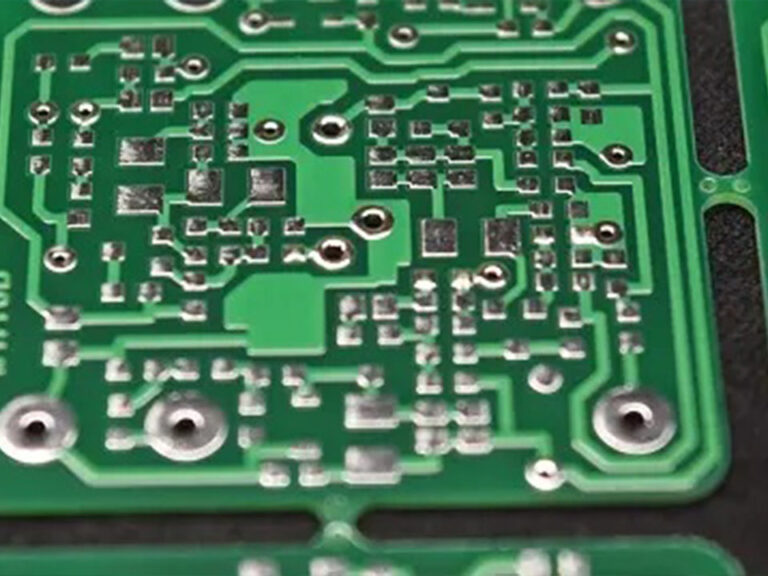
HASL coats pads with solder, then uses hot air to level it. It’s popular because it’s forgiving during soldering.
HASL: cheap, solders well, but it isn’t very flat
HASL often wins when you’re pushing BOM cost down and your land patterns aren’t razor-thin. You get a wide process window during SMT, and hand-solder feels easy.
The trade-off is planarity. The solder layer can vary across pads, so ultra-fine pitch can suffer. If your design lives in the “fine-pitch danger zone” (tight QFN leads, small passive pads, dense connectors), HASL can raise your risk of skewed parts, inconsistent paste volume needs, and nuisance defects that burn time in AOI + rework.
HASL: where it fits in real production
Industrial control boards with larger components and robust pad sizes
Service/repair builds where techs hand-solder often
Prototypes that need quick, forgiving assembly
If your project leans toward straightforward fabrication first, start from PCB fabrication . For a concrete HASL-style scenario on your site, see a HASL-focused product page like smoke alarm sensor PCB with HASL .
ENIG (Electroless Nickel Immersion Gold)
ENIG uses a nickel layer as a barrier and a thin gold layer to protect the surface. In assembly terms, you’re buying flat pads and stable storage.
ENIG: very flat for BGA and fine pitch, but it costs more and needs process control
ENIG’s big advantage is planarity, which matters when you run BGA, QFN, tight pitch connectors, or dense HDI. Flat pads help paste print consistency, which is half the battle for yield.
ENIG also supports multiple reflow and rework loops better than finishes that age fast. That’s why you see it a lot in OEM programs where boards move between EVT/DVT/PVT and keep changing.
The “watch-out” is manufacturing control. ENIG requires tight chemistry and inspection discipline. A serious factory will treat this like a controlled process, not an afterthought.
ENIG: where it fits in real production
HDI and fine-pitch builds where you can’t afford coplanarity drama
Medical and automotive electronics where reliability and traceability matter
RF and high-speed boards where you’re already controlling impedance and stackup
If you want a matching internal example, your site has ENIG-related pages like high-frequency 6-layer PCB with ENIG pads . When you pair ENIG with assembly, make sure your flow matches your PCB assembly service details .
OSP (Organic Solderability Preservative)
OSP is a thin organic coating that protects copper from oxidation. It’s simple and very flat, which sounds perfect—until you look at storage and handling.
OSP: low cost and flat, but it’s sensitive and has shorter shelf life
OSP can perform great when boards move fast from fab to SMT. It also plays well with fine pitch because the coating is thin and doesn’t create bumps.
But OSP is “pickier” in the real world. Fingerprints, humidity, and long storage can hurt solderability. If your buyer ships boards to multiple contract manufacturers, or if your production line pauses often, OSP can turn into a hidden schedule risk.
OSP: where it fits in real production
High-volume SMT with stable scheduling and quick inventory turns
Cost-driven consumer control boards that don’t need long shelf storage
Immersion silver deposits a thin silver layer on copper. Like ENIG and OSP, it’s very flat, which helps with fine pitch. The big difference is how sensitive it is to contamination.
Immersion silver: flat and solderable, but it needs clean handling and good packaging
Immersion silver can deliver strong solder wetting when boards stay clean. That’s the key phrase: stay clean. Fingerprints, sulfur exposure, and sloppy storage can cause tarnish or solderability shifts. In factory slang, this finish punishes “bare-hand ops” and sloppy warehouse habits.
If you run disciplined packaging, controlled humidity, and fast consumption, immersion silver can be a solid choice for tight geometry.
Immersion silver: where it fits in real production
Fine-pitch SMT where you want flat pads but don’t need nickel underlayer behavior
RF/high-speed builds that already enforce handling rules
OEM/EMS programs with consistent logistics and clear receiving inspection
For programs that demand repeatability, link your finish choice to your QC plan on the Quality page .
How to choose a surface finish for SMT, BGA, rework, and shelf life
Use this checklist like a quick DFM filter. It avoids “spec-by-habit” and keeps your build aligned with real risks.
Fine pitch and BGA flatness
If you have BGA/QFN/fine pitch, lean toward ENIG or immersion silver.
If your smallest pads are generous and you don’t run dense BGAs, HASL can work.
Reflow cycles and rework loops
If you expect multiple reflow passes, engineering changes, or rework, ENIG usually gives you more breathing room.
If your line is stable and boards move fast, OSP can be fine.
Storage, shipping, and handling discipline
If boards may sit in inventory or ship across regions, pick a finish with better storage tolerance (often ENIG).
If the factory floor can’t guarantee clean handling, avoid finishes that get angry at fingerprints (often OSP and immersion silver).
Turnkey flow and accountability
If you want one party to own the full chain—DFM, fabrication, and PCBA—tie the finish decision into your Services scope and confirm responsibilities early. When you’re ready to kick off, route specs and questions through Contact Us .
Common buyer scenarios: OEM, EMS, prototype, mass production
OEM + brand owners: You’ll care about stable quality across suppliers and long program life. ENIG often fits because it reduces variability and supports rework.
EMS/contract manufacturers: You’ll care about paste print, AOI yield, and low rework time. Flat finishes (ENIG/immersion silver/OSP) help, as long as handling is tight.
Startups and R&D labs: You’ll iterate fast. ENIG helps when designs change and boards get reworked, while HASL can be okay on simple prototypes.
Maintenance/spares: Boards may sit in storage. Pick a finish that tolerates shelf time and shipping without turning soldering into a lottery.
If you tell me your minimum pitch, whether you have BGAs, how many reflow passes you expect, and your storage window, I’ll map one finish to your use case and explain the trade-offs in one short recommendation.
MC PCB.,Ltd, alongside Dongguan MaoChang Printed Circuit Board Limited,has focused on PCB manufacturing over 20 years. MaoChang Printed Circuit Board Limited, a professional PCB factory for Quick Turn PCB, Prototype PCB and High Mix Low Volume fabrication. With UL certification for Rigid FR-4 / High Frequency / Aluminum Based PCB production.
Company
About
Contact
Capabilities
Services
Application
Products
Quality
Blog
Products
Printed Circuit Boards
PCB Prototype
Flexible PCB
High Frequency PCB
Thick-Copper PCB
PCB Assembly
Metal core PCB
Thick-Copper PCB
Contact
0755-2889 4567
Room 1803, lA Building, Longwan, Nanhuai Road, Shajing, Bao'an District,Shenzhen City
No. 2, Lane 11, Wenming Road, Fourth Industrial Zone, Nanzha, Humen Town, Dongguan City