One-Stop PCB Factory: Prototype to Mass Production
For hardware startups and OEMs, getting high-quality PCBs quickly and reliably is critical. MC PCB is a one-stop contract PCB manufacturer supporting prototypes to volume builds—backed by experienced engineering support and rigorous QA.
MC PCB Co., Ltd.
Began in 2005
One-Stop PCB Factory: Prototype to Mass Production
For hardware startups and OEMs, getting high-quality PCBs quickly and reliably is critical. MC PCB is a one-stop contract PCB manufacturer supporting prototypes to volume builds—backed by experienced engineering support and rigorous QA.
MC PCB Co., Ltd.
Began in 2005
No. 2, Lane 11, Wenming Road, Fourth Industrial Zone, Nanzha, Humen Town, Dongguan City
If you’ve ever stared at a quote and thought, “Why is this board so expensive? It’s just copper and FR-4,” you’re not alone. Most of the cost isn’t the raw material. It’s the process friction: setup, handling, yield loss, depaneling, and test flow.
This guide breaks down how to pick between one big breakaway PCB and multiple small boards in a panel. It’s written for OEMs, EMS teams, design houses, hardware studios, and labs that need fast prototyping today and stable mass production tomorrow. If you want a factory-side view across fab + SMT + QC, start from the China PCB B2B factory: fast prototyping, reliable assembly page.
PCB cost drivers: setup cost, area cost, assembly cost
A clean way to think about PCB cost is this: you’re paying for machines to stop, change, align, and run again.
If you want a one-stop flow where the fab and SMT teams can align on constraints early, it helps to anchor your decision around your manufacturer’s PCB fabrication and PCB assembly process expectations.
Single large PCB vs panelization: what changes, what stays the same
Here’s the key: your total copper area often stays similar, but the “tax” around it changes.
Bare PCB cost follows area + setup
If you build one large PCB that later breaks into smaller units, you might not magically lower the board price. Many shops still price the core board around size + complexity + setup.
Where you can win is by reducing:
repeated engineering steps,
repeated tooling decisions,
repeated quoting and changeovers.
That’s why you’ll hear factory people say, “Cost isn’t just board size. It’s how many times the line has to reset.”
Panel utilization decides waste
A big board can be a space hog. If its outline doesn’t nest well, you burn panel real estate. That waste shows up as cost and longer lead time because fewer good units come out of each production cycle.
A multi-up panel often packs better. You can rotate small boards, add rails, and reduce dead zones. This is a classic “sheet metal nesting” problem, just with copper and solder mask.
Assembly is where panelization pays back
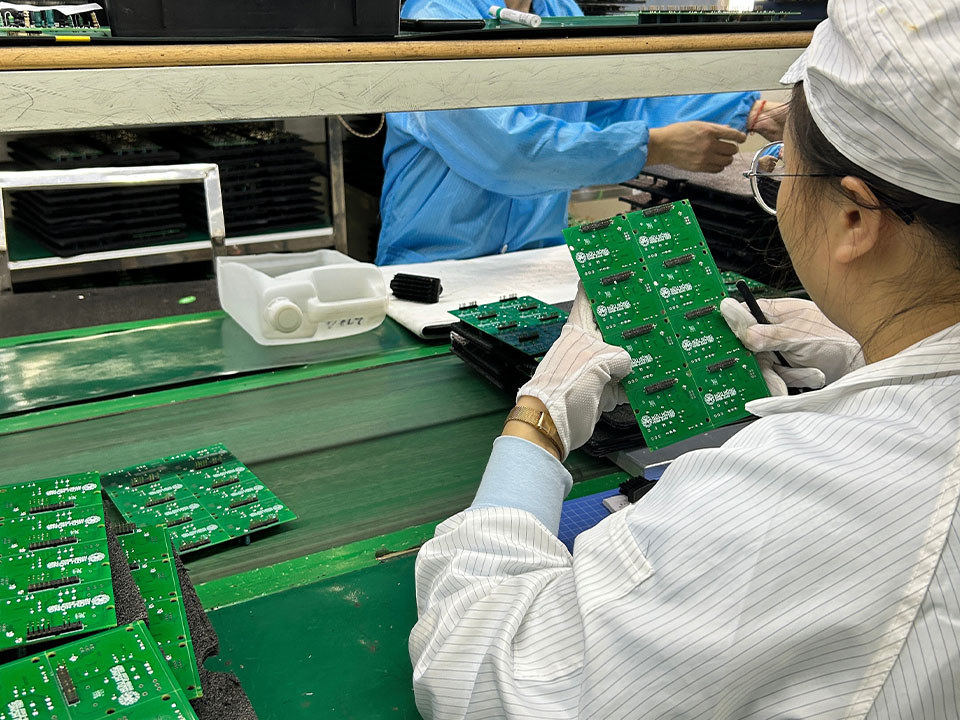
SMT lines love panels because panels are predictable:
stable conveyor grip on rails,
consistent fiducials,
repeatable paste print,
fewer touch points for operators.
If your boards are tiny, odd-shaped, or connector-heavy near the edges, a panel with rails can be the difference between smooth throughput and constant line babysitting.
Depanelization method can flip the decision
When you separate boards, you can add stress. Stress can crack ceramics, pop BGA joints, or create hairline fractures that only fail after thermal cycling.
Your choice here affects both yield and downstream returns. That’s why depanel strategy belongs in the cost discussion, not as an afterthought.
Vendor pricing rules can dominate
Some vendors price small prototypes aggressively. Others price panels as a special class. The point is simple: quoting logic varies, and it can overpower your design theory.
When you scale to wholesale and OEM/ODM, you want pricing rules that stay stable. That’s where talking to a supplier through a proper contact channel early can save you multiple ECO loops.
Panel utilization and standard panel size in PCB manufacturing
Most production lines prefer standard working sizes. Even if you never see those numbers on a quote, the factory plans around them.
If you push a single large PCB close to a line’s handling limit, you can trigger pain:
warpage risk rises,
solder paste print gets less stable across the span,
depaneling gets awkward,
packaging damage goes up.
A well-designed panel solves these issues by adding:
rails for conveyor grip,
tooling holes for fixtures,
fiducials for vision alignment,
breakaway features that keep the board rigid until the end.
If your design is complex (HDI, impedance, fine pitch), read your supplier’s capability boundaries first. The fastest way is to check capabilities before you lock the mechanical plan.
SMT assembly cost and handling: panelization for throughput
SMT cost doesn’t just come from placements per board. It comes from takt time and changeover friction.
Panelization can reduce:
per-unit loading and unloading time,
mispicks caused by unstable tiny boards,
reflow movement on lightweight parts,
AOI false calls from inconsistent alignment.
Real SMT scenario: mainboard + daughterboard split
A common product stack looks like this:
a main board (MCU, power, RF),
a small interface board (USB, connectors),
sometimes a sensor board.
If you combine everything into one big PCB, you may simplify assembly once. However, you might also create a board that’s harder to test and harder to rework.
If you panelize, you can:
keep high-risk RF sections isolated,
run the same small sub-board across multiple SKUs,
reduce the blast radius when one section changes.
For OEM and EMS teams, this modular strategy cuts churn during late-stage revisions. For factories that run turnkey, it also reduces confusion in kitting and line setup. If you build boards with demanding constraints, the advanced PCB route often pairs well with panel rules that protect yield.
Depanelization: V-score vs tab-routing vs breakaway tabs
Depaneling is where cost, reliability, and design rules collide.
V-score
Use V-score when:
your board edges are straight,
you can keep sensitive parts away from the score line,
you want fast, clean separation.
It’s usually efficient because it’s simple for the fab and easy for the factory floor.
Tab-routing and breakaway tabs
Use tab-routing when:
your outline is irregular,
you need curved edges,
you must control stress direction.
Tabs often use mouse-bites. They’re practical, but they can leave rough edges. That matters for enclosure fit and for cosmetics on consumer devices.
Reliability pain point: “It passes test, then fails in the field”
This happens when depanel stress creates microscopic damage that doesn’t show up in a quick bench test. If your product lives in vibration, automotive, industrial control, or warm enclosures, treat depaneling like a reliability step.
If you’re building high-reliability units, anchor your process around a strict QC path. Your buyers will ask about it anyway. Point them to your quality page when you discuss yield and shipment stability.
Decision table: single large PCB vs multiple small boards through panelization
Cost / risk driver
Single large PCB with breakaway tends to win when…
Multiple small boards in a panel tends to win when…
Setup friction
You can reduce repeated CAM/tooling steps and keep revisions simple
You need modularity and frequent sub-board reuse across SKUs
Panel utilization
The big outline nests cleanly with low waste
Small boards pack tighter with better nesting flexibility
SMT throughput
Handling stays stable without extra rails
Tiny or odd shapes need rails, fiducials, and stable conveyor flow
Test strategy
One combined test setup is simpler
You want per-sub-board debug, swap, and reuse across projects
Depanel risk
Parts stay far from edges and stress-sensitive zones
You can choose V-score or tab-routing based on outline and risk
Engineering change control
ECOs are rare and mechanical stays fixed
ECOs are common and you don’t want to respin a huge board
PCB cost optimization for OEM/ODM, wholesale, and prototype builds
Different buyer types feel pain in different places:
OEM and brand owners
You care about consistent yield and stable supply. Panelization often helps because it makes assembly predictable and cuts operator variability. When product ramps, “predictable” beats “clever.”
EMS and contract manufacturers
You want smooth line balancing, fewer stoppages, and clean AOI. Panels help you hit takt time without random surprises.
Design houses, labs, and startups
You iterate fast. Modular small boards let you change one section without respinning the whole system. If you’re in early-stage prototyping, check a service entry point like custom PCB board prototype manufacturing so your layout choices stay aligned with build reality.
Real product-style examples that usually benefit from panelization
Control boards with connector-heavy edges: panel rails protect connectors and keep pick-and-place stable.
RF + baseband splits: keep RF sections on controlled stackups while leaving the rest easier to revise.
DFM checklist for panelization cost optimization
Use this list before you send Gerbers. It’s short, but it kills most quote surprises.
Add rails if the unit board can’t ride the conveyor safely.
Place global and local fiducials with clear solder mask clearance.
Keep edge-sensitive parts (MLCC, BGA, fine-pitch) away from depanel lines.
Pick V-score only when geometry and keep-outs allow it.
For tabs, plan mouse-bite placement so breakout force doesn’t hit fragile zones.
Decide whether you want single-up testing or panel-level testing, then design test pads accordingly.
Align stencil strategy with panel layout to avoid paste print issues.
Confirm material, stackup, and impedance needs early if you’re building RF/HDI.
If you want to talk through a panel plan with both fab and SMT in mind, it helps to route the question through one team instead of bouncing between vendors. That’s the practical value of a factory that covers prototyping, mass production, and assembly under one roof, like the service path outlined on the services section.
Next step: choose the option that protects yield, not just unit price
If you only optimize for a lower board quote, you can lose money later in rework, scrap, and returns. The best choice is the one that keeps the whole chain calm: fab, SMT, test, packing, and field life.
If you tell me your board outline, rough component density, and whether you need V-score or tab-routing, I can map it to a clean panel strategy and the DFM checks that usually prevent quote spikes.
MC PCB.,Ltd, alongside Dongguan MaoChang Printed Circuit Board Limited,has focused on PCB manufacturing over 20 years. MaoChang Printed Circuit Board Limited, a professional PCB factory for Quick Turn PCB, Prototype PCB and High Mix Low Volume fabrication. With UL certification for Rigid FR-4 / High Frequency / Aluminum Based PCB production.
Company
About
Contact
Capabilities
Services
Application
Products
Quality
Blog
Products
Printed Circuit Boards
PCB Prototype
Flexible PCB
High Frequency PCB
Thick-Copper PCB
PCB Assembly
Metal core PCB
Thick-Copper PCB
Contact
0755-2889 4567
Room 1803, lA Building, Longwan, Nanhuai Road, Shajing, Bao'an District,Shenzhen City
No. 2, Lane 11, Wenming Road, Fourth Industrial Zone, Nanzha, Humen Town, Dongguan City